
Your physical Point of Sale is no longer an isolated destination; it is the final terminal of a hyper-connected digital ecosystem. In 2026, retail marketing success is no longer measured by mere “ranking” on Google Maps, but by the ability to eliminate the Organizational Friction that separates static warehouse data from the real-time perception of the consumer.
Today, the optimal integrated experience for the consumer is one that seamlessly merges the digital and retail dimensions. This is not a choice, but an ontological necessity: the customer no longer distinguishes between “online” and “offline.” They inhabit a fluid dimension where product availability must be certain, immediate, and geolocalized.
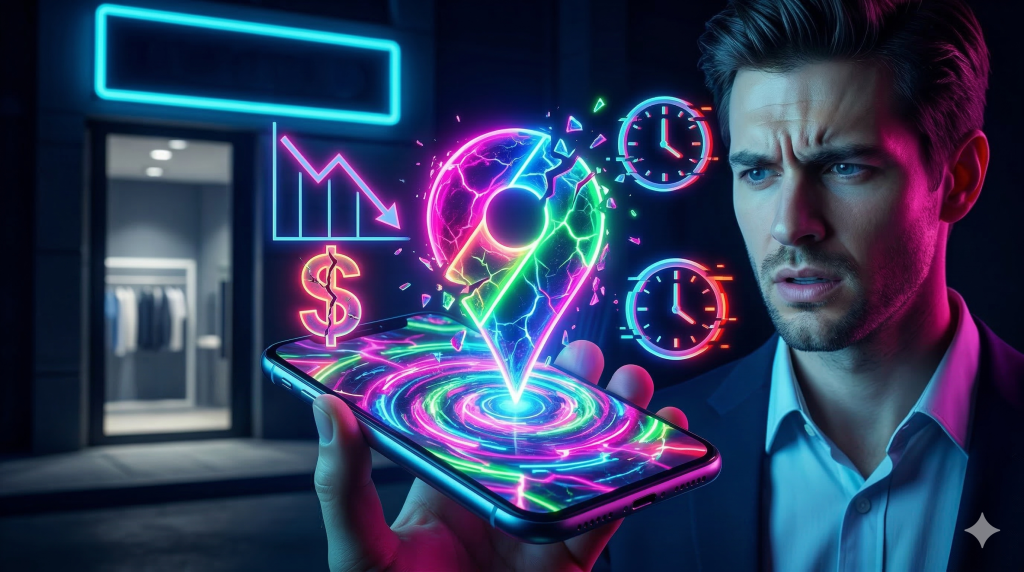
The Diagnosis: The Cost of Uncertainty in the Digital First Era
For a Head of Retail, the primary risk today is not invisibility, but imprecision. In a market saturated with stimuli, the Digital First consumer does not merely seek inspiration; they seek certainty. They need to know that a specific product, in a specific variant, is available “here and now.”
Without robust Organizational Synchronicity, the digital signal decays. Every Digital Retail Marketing strategy loses its efficacy if the promise made on a screen is not immediately matched by the reality on the shelves. In our experience, we have observed top-tier manufacturing and retail companies wasting massive investments in digital campaigns simply because their front-end (Google Maps or the corporate website) was unable to communicate with the logistical back-end(ERP).
This technological silence creates an information vacuum that the consumer fills by turning to the competition. Uncertainty is the primary accelerator of abandonment.
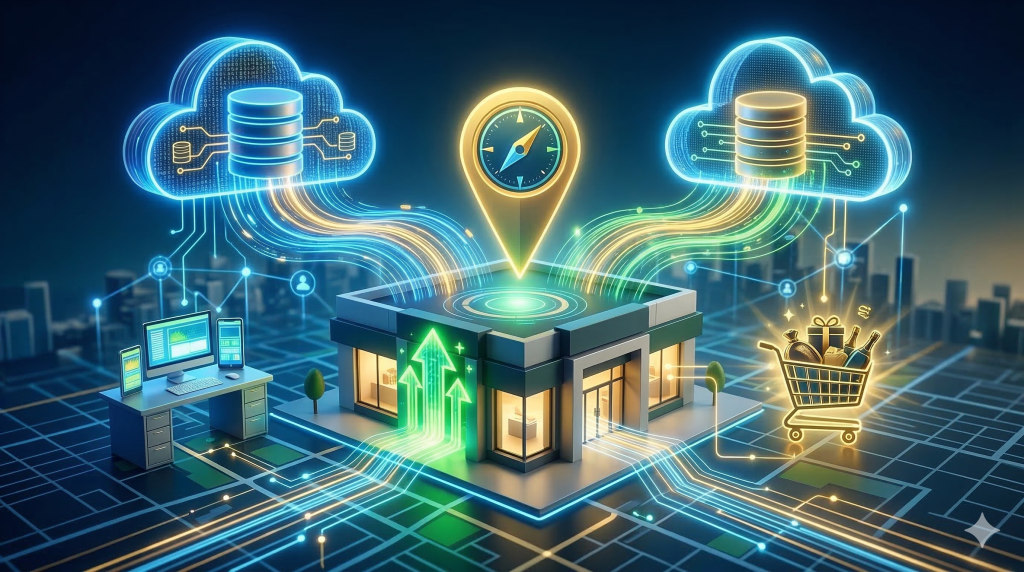
Case Study: Real-Time Synchronization and Strategic Success
We recently supported a leading retail enterprise that had reached a standstill. Despite having defined a sophisticated Retail Marketing strategy through an external agency, results were stagnant. The agency’s approach was purely aesthetic and communicative, ignoring the deep mechanisms that regulate Financial Velocity.
Following a thorough analysis, we identified and removed structural frictions by directly connecting the corporate ERP to the website, creating an Onlife interaction ecosystem between the physical store and Google Maps profiles.
The Architecture of Transparency
This new infrastructure allowed users to view the specific real-time availability of every reference in each individual Point of Sale. Transparency was not just a customer service feature; it was the true engine of the marketing strategy. The data emerged as follows:
- +15% Targeted Visits: Customers arrived at the store with the “mathematical certainty” of availability, eliminating the “bounce effect” (where a user searches, finds no confirmation, and switches brands).
- +4% Upselling: The reassurance obtained online created a climate of trust that, once in-store, facilitated the transition toward premium product versions.
- +6% Cross-selling: Guaranteed availability incentivized the purchase of accessories and complementary products that the user had already begun exploring digitally.
This process is not simple e-commerce: it is Signal Intelligence™. We transformed cold warehouse data into a dynamic competitive advantage that accelerates the speed at which invested capital returns to the company as revenue.

From Strategy to Execution: The Synchronicity Protocol
For this architecture to function, technology alone is insufficient; a management protocol is required to align information flows between IT, Marketing, and Sales departments. It is not merely about “adding the business to Maps.” Integrating the store into a digital retail strategy means ensuring that every product is synchronized with the needs and expectations of the modern consumer.
The ultimate goal is the creation of a flow where logistical data fuels marketing creativity, and the latter generates qualified traffic based on reality, not hope.
Glossary and FAQ: Navigating the 2026 Strategy
In this section, we delve into the key terms for understanding the convergence between technology and the market.
What is Upselling and why is it vital for Retail?
Upselling is a sales technique intended to encourage the customer to purchase a higher-end, more advanced, or more expensive product than the one initially considered. In Digital Marketing for Retail, digital upselling occurs by providing value-added content and technical comparisons directly on the Google Maps profile or website, leading the customer into the store already oriented toward the “top of the range.”
What is Cross-selling and how does it impact margins?
Cross-selling consists of offering complementary products or services related to the primary purchase. If a customer knows they will find both the camera and the specific lens in-store (availability guaranteed by the ERP), the probability of a combined purchase increases drastically, optimizing customer acquisition costs.
What is meant by the Onlife Consumer?
The term Onlife, coined by the Italian philosopher Luciano Floridi, indicates that the distinction between online and offline is now obsolete. The Onlife consumer lives in an infosphere where the two dimensions are fused: they check their smartphone while touching the product on the shelf.
What is meant by Phygital?
Phygital is the portmanteau of Physical and Digital. It represents the strategic approach through which a company creates physical touchpoints enhanced by digital tools (e.g., in-store QR codes, Virtual Tours on Maps, contactless payments).
What is the difference between Phygital and Onlife?
Onlife is the existential condition of the consumer (how they live), while Phygital is the strategic response of the company (how it intercepts them). The former is the “context,” the latter is the “tool”.
What is Digital Retail?
Digital Retail is the evolution of brick-and-mortar commerce where every phase of the customer journey is enabled by technology, transforming the physical store from a simple warehouse open to the public into an integrated experiential and logistical hub.
What is the difference between Digital Retail Marketing and Multi-channel Marketing?
Multi-channel Marketing limits itself to occupying multiple channels (Social, Web, Store), often in a disconnected manner. Digital Retail Marketing (or Cross-channel) presupposes that channels are integrated: what happens on one channel has an immediate and visible impact on the others.
What is the difference between a Point of Sale and a Shop?
A “Shop” is a traditional concept linked to the exchange of goods for money. The modern Point of Sale is a multifunctional hub: it is a distribution center for click-and-collect, a set for content creation, a consulting venue, and a data collection point for Signal Intelligence™.
What is an ERP and how does it differ from a CRM?
ERP – Enterprise Resource Planning, is the management heart of the company. It handles logistics, warehouses, production, and accounting. It knows “what” you have and “where” it is.
While the CRM – Customer Relationship Management), handles the relationship with customers. It knows “who” the user is, what they prefer, and how to contact them. For a successful strategy, the ERP confirms if the product exists; the CRM identifies who to offer it to. Their integration is the key to Organizational Synchronicity.

 Spotify
 Amazon Music
 Apple Podcasts
 YouTube
 RSS
RSS