Augmented Reality and Cosmetics: 3 case studies that show how augmented reality can involve the Millennials
By Enrico Giubertoni
Trusted by
Worldline
Alba Leasing
L'Erbolario
3M
What is the role of Augmented Reality in engaging the cosmetic customer? What role does Augmented Reality play in creating a positive product experience in cosmetics?
Augmented reality is progressively gaining more and more importance within the cosmetics industry.
Among the forerunners we have great brands that have embraced digital innovation such as L’Oréal Paris and Sephora.
Alongside the big brands, there are also new outsiders who are gaining market share: this is the case of PerfectCorp, the company that created the well-known Augmented Reality YouCam MakeUp App in 2014.
What is Augmented Reality and why is it so interesting for the cosmetics industry?
Augmented Reality (A.R.) is a virtual reality technique, through which information is added to the real life scene.
For this reason Augmented Reality can add additional information to everyday elements, such as – to give an example – a mirror.
Let’s imagine this Example: we are away from home and we don’t have our mirror with us for cosmetic use. We can open the front camera of our Smartphone and use it as a mirror.
This is a basic and very do-it-yourself scenario.
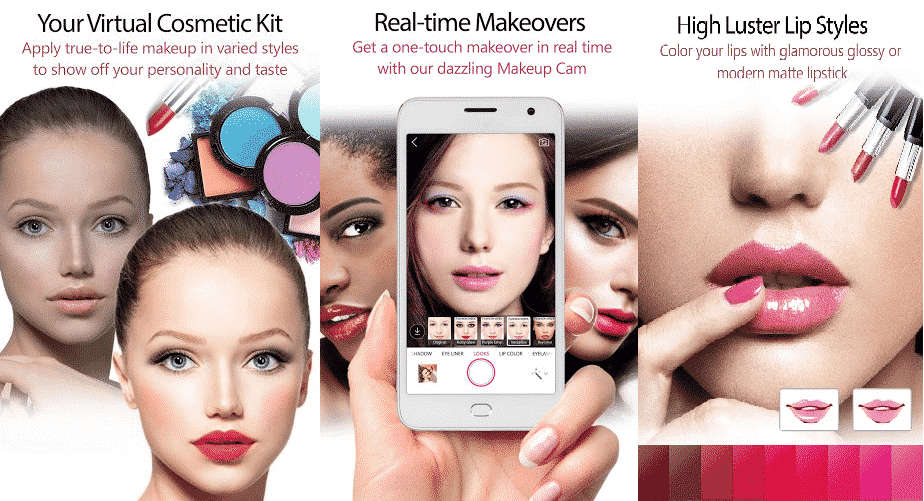
With augmented reality based apps we can add valuable information for the cosmetic customer as you can see in this video from the YouCam MakeUp app.
And for this reason there is a growing interest in Augmented Reality and more generally in this category of applications related to Digital Innovation for Strategic Marketing in the cosmetics industry.
The reason for this interest is not only because they want to be perceived as pioneers of digital innovation, but above all because these technologies allow to:
increase the cosmetic user experience
understand and profile their preferences
create a totally personalized offer (OneToOne Marketing)
Examples of Augmented Reality Applications related to eCommerce and cosmetic retail.
Augmented reality applications create a highly articulated relationship with the cosmetic retailer.
These new types of media I decided to call them Product Media because these Apps actually work as Media Channels with the peculiar feature of being totally customized to the needs of the end user.
Youcam MakeUp App – The Catalogue App
The Youcam MakeUp App – available on Android and iPhone – is the industry’s first app, launched in 2014.
It passed 100 million downloads on iOS and Android in January 2016 (Cosmetics Business, 2016) and by early 2021 it counted about 40 to 50 million monthly active users (TechCrunch, 2021), including an integration with the WeChat app that is used extensively in China.
Originally created to create Virtual Selfie with your Smartphone, the app has transformed its approach into a link between:
Product Testing via Augmented Reality
Links to eCommerce sites
Links to PHYSICAL STORES (Retail Shop)
Its catalogue includes products and tools from over 200 top beauty brands including (L’Oréal, Estée Lauder, etc.).
These apps are very famous in the world of Millennials and Post Millennials.
The fact that brands like L’Oréal decide to use these apps as if they were social channels is emblematic.
In fact, these apps are transformed into a new media (technically it’s a Paid Media) on which to make promotional campaigns to increase their branding and sales.
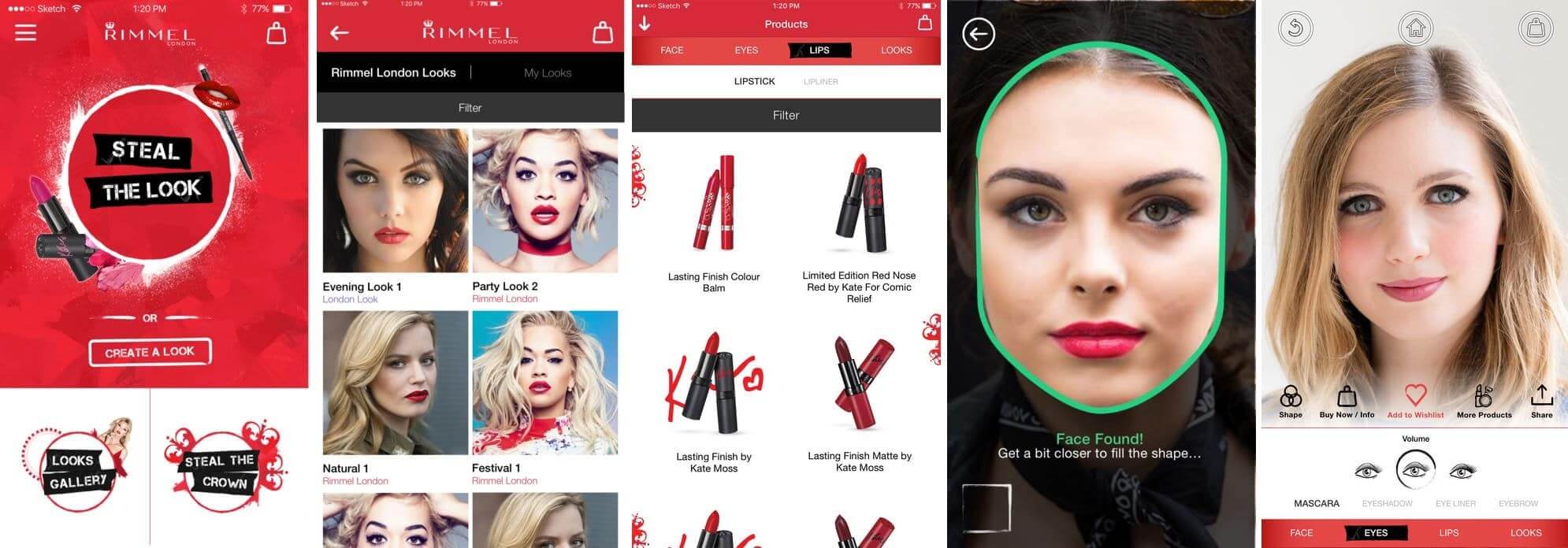
Get The Look, Rimmel’s app
Like the look of your friend, a model or a celebrity? Capture it and try it now thanks to Rimmel London’s revolutionary app, Get The Look! You’ ll be able to experience augmented reality in 3D and try out your favorite look on your face.
With this claim Rimmel London explains the function of his App Get The Look. Based on augmented reality, it allows the millennials to:
photograph the face of a celebrity or an influencer or a friend.
Superimpose your own face in semi-transparency
Try Rimmel products to get closer to the effect you want to achieve.
Get The Look is thus a Semi Mirror, a semi-transparent mirror that allows you to:
Inspire yourself to people who appreciate you (friends, influencers, celebrities)
Approaching their way of being
Use Rimmel products
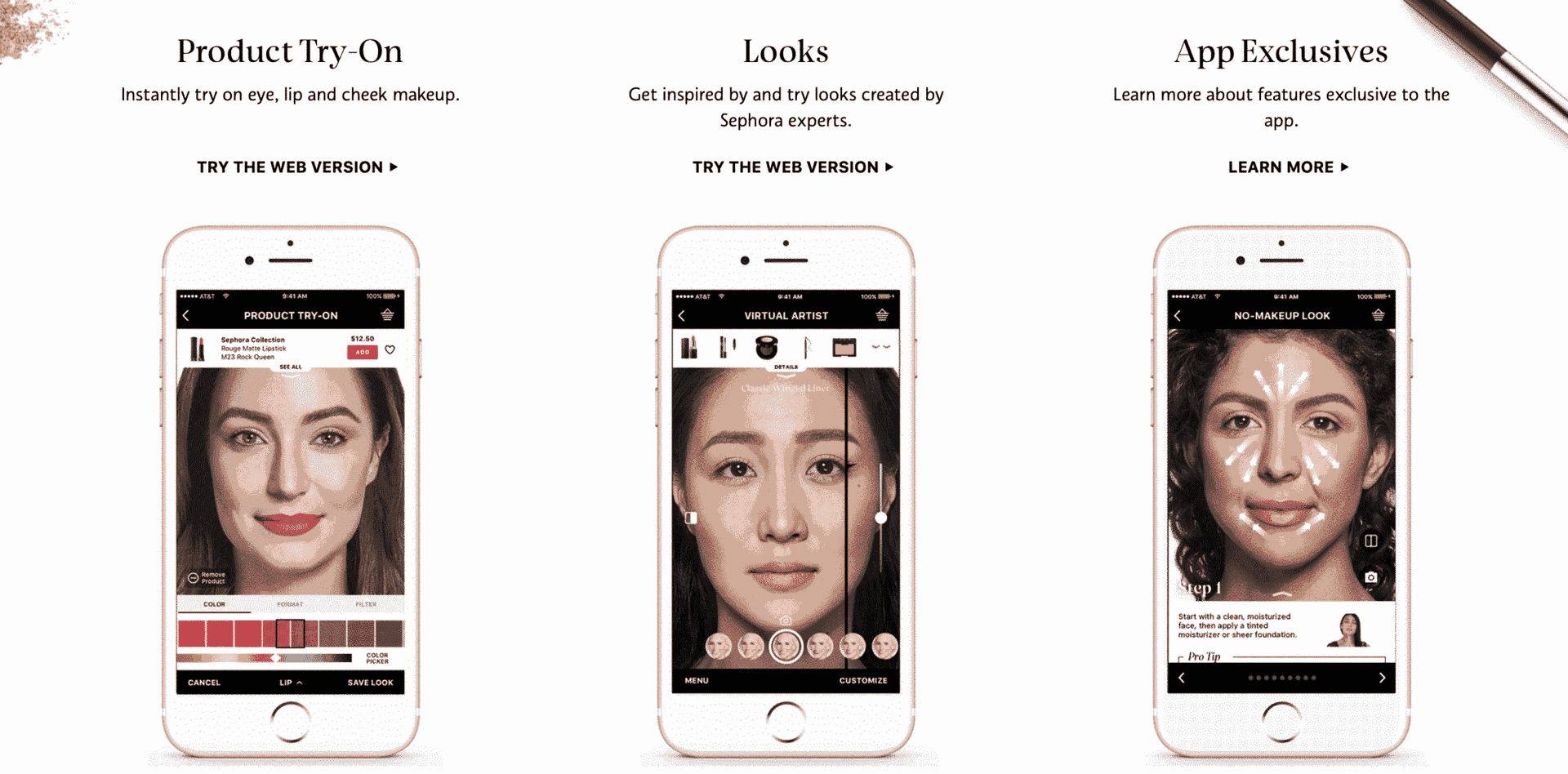
Sephora – Buy Makeup, Cosmetics, Hair & Skincare (Sephora USA)
This App on Augmented Reality (and not only) allows a strong integration between:
App as a moment of user experience
eCommerce for an App purchase
As a result it has a strong #Onlife integration with the physical stores of the Sephora Store network.
By using the App the consumer can try their own makeup (in a similar way to the previous ones) and discover the best of the shopping experience on beauty, skin care, perfumes and other products in the catalogue.
The app allows through augmented reality to make a digital makeover, to find and try the latest styles and trends.
With the help of Virtual Artist, the app provides professional and makeup advice tailored to the style of each user.
Virtual MakeUp through App allows you to find foundation, palette, lipstick and more in a way that fits your personal styles, enriching each user profile with valuable information (Customer Persona).
This user experience is conveyed to two channels:
The Online Shopping channel
The Physical Shopping Channel
Three augmented reality apps in cosmetics
App
Brand
What it does
YouCam MakeUp
PerfectCorp (launched 2014)
Catalogue app linking AR product testing to e-commerce sites and physical stores
Get The Look
Rimmel London
Semi-transparent mirror: capture a look, overlay your face, try Rimmel products
Sephora app
Sephora
Digital makeover with Virtual Artist, linked to online shopping and the Sephora store network
Source: Elaborazione di Enrico Giubertoni
Benefits of Augmented Reality for consumers
From these examples it is evident that with augmented reality a cosmetic consumer is able to have a product experience emancipating from Space, Time, Product Presence:
Augmented reality allows the cosmetic user to try products in spaces even outside the point of sale.
As a resultAugmented reality allows the cosmetic user to try products that are different from the canonical ones.
For this reason Augmented reality allows the cosmetic user to try products in a “virtual” way before buying products in a real way.
As a result Technology makes it possible to interconnect people who would never be in contact without it.
For cosmetic companies, we:
Have invaluable information about the user’s wishes (Persona)
We are able to provide an Ubiquitous User Experience (if you are interested in learning more I wrote a post about the user experience in cosmetics), a total and enveloping, almost holistic user experience that allows us to create an in-depth user profile (If you want to know more I suggest you read the post about Persona)
Frequently asked questions
Why is augmented reality relevant for the cosmetics industry?
Because augmented reality adds information to real-life scenes, turning something as ordinary as a smartphone camera used as a mirror into a tool that shows the cosmetic product on your face. Brands invest in it not only to look like pioneers, but because it increases the cosmetic user experience, profiles preferences and enables a fully personalized one-to-one offer.
Which cosmetic brands use augmented reality apps?
Among the forerunners are L’Oréal Paris and Sephora, alongside outsiders such as PerfectCorp, which created the YouCam MakeUp app in 2014. Other examples are Rimmel London’s Get The Look, which lets you copy the look of a friend, a model or a celebrity, and the Sephora app with its Virtual Artist.
What are the benefits of augmented reality for consumers and cosmetic companies?
Consumers can try products outside the point of sale, try products different from the usual ones and test them virtually before buying. Cosmetic companies gain invaluable information about the user’s wishes (the Persona), can drive users to the point of sale with incentives and can provide an ubiquitous, almost holistic user experience.