Marketing automation:how to read and answer the needs of your target
By Enrico Giubertoni
Trusted by
Worldline
Alba Leasing
L'Erbolario
3M
Marketing automation is the use of software to identify the needs of a target (the group of people a company wants to reach) and to answer them with campaigns that adapt by themselves to the moment of purchase. The output is a business result: the company understands what its customers want, and when.
In this article:
what marketing automation is, starting from a definition by Neil Patel
how a company can use a marketing automation platform, and which functions must govern it
why the cosmetics sector is a natural field for it
What is marketing automation, and why it matters for cosmetics
I start from a definition given by Neil Patel, a digital marketing author, adapted to the cosmetics sector.
Marketing automation is the use of software solutions based on artificial intelligence, advanced algorithms (sequences of calculation rules) and semantic systems (which interpret the meaning of language) to automate marketing processes such as advanced segmentation of customers by interest and the integration of big data (very large collections of data) and customer data, all directed to the management of the campaigns of a cosmetics brand.
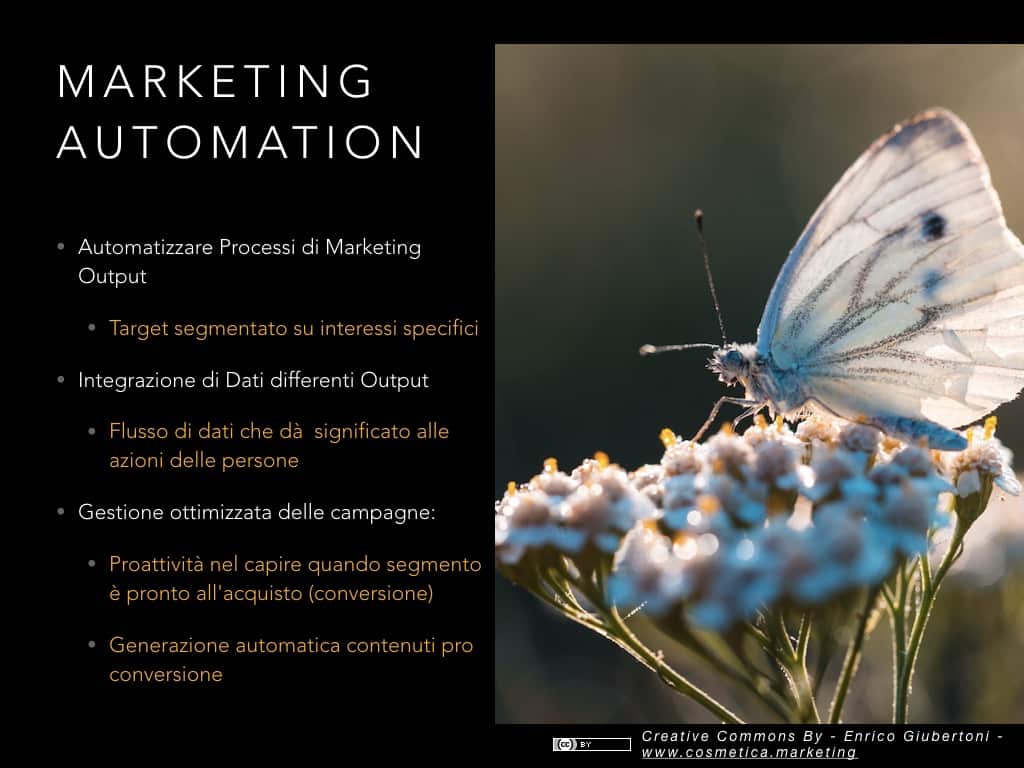
The benefits of marketing automation platforms. Creative Commons By, Enrico Giubertoni, cosmetica.marketing
Integrate data. Automation brings together data from different sources. The output is a flow of data that gives meaning to the actions of people.
Capture the needs and intentions of the target. Campaigns (email marketing, social ads, search engine advertising, organic content) run automatically. The output is campaigns able to recognise when a segment is ready to buy (conversion, the moment a contact becomes a customer) and to support that moment with dedicated content.
Marketing automation is therefore valuable for a company because its output is the identification of the needs of the target, and a response to them.
Marketing automation platforms: several departments must govern them
With marketing automation platforms a company has the tools to personalise its campaign automatically for each of its targets and direct it to conversion.
Let us take this sentence apart:
Personalise automatically. Marketing automation platforms build a strategy of messages designed to generate the desire to buy.
The campaign. The interesting fact is that the platforms register when a target is ready to buy, and modify their strategy to adapt it to that customer.
Directed to conversion. Each target converts in its own way. The platforms exist to optimise conversion.
In this sense, marketing automation platforms allow a company to:
Specify the target in an advanced way
Define a campaign strategy, built with machine learning (systems that improve from data), that accompanies the target through the three stages of the customer journey known as nurturing (the process that generates the desire to buy): interest, desire, purchase
Optimise messages so that they match the specific needs of the target
Which functions must govern a marketing automation platform?
Several, together. A platform sits where the work of different departments meets, and no single department holds all the pieces.
Here the organisation enters the picture:
Marketing owns segmentation, the choice of which groups of customers to address.
Sales and IT often own the customer data, which feeds the platform.
Communication owns the content of the campaigns, which gives the segments something to read.
For this reason a single department cannot govern the platform alone. Coordination between functions is the condition for results: they must share the same definitions (what counts as a ready customer, for instance), the same objectives and the same calendar. Without that agreement the platform automates the disagreements of the organisation.
Marketing automation for cosmetics: emotional variables
All this is particularly relevant for the cosmetics target, because:
nurturing rests on emotional variables
the cosmetics target is more sensitive, compared with other sectors, to communication based on its specific needs
A skincare or make-up purchase is rarely a rational comparison of features. It is a response to a feeling about oneself, and the message that arrives at the right moment, written for that specific need, speaks to that feeling. This is what a platform that personalises messages for each segment makes possible at scale.
Frequently asked questions
What benefits does marketing automation bring to a company?
Three main benefits. It automates processes, giving algorithms the task of crossing complex data to obtain segments built on the interests of the target; it integrates data from different sources into one flow that gives meaning to the actions of people; it captures needs and intentions, recognising when a segment is ready to buy and supporting that moment with dedicated content.
How does a marketing automation platform accompany the customer to purchase?
It personalises messages for each target automatically and directs them to conversion. The platform registers when a target is ready to buy and adapts the strategy, accompanying it through the three stages of nurturing (the process that generates the desire to buy): interest, desire, purchase. Each target converts in its own way, and the platform optimises accordingly.
Why is marketing automation especially useful in cosmetics?
Because in the cosmetics sector nurturing rests on emotional variables, and the target is more sensitive than in other sectors to communication built on its specific needs. The capacity to personalise messages for each segment answers exactly this need.
Which department should govern a marketing automation platform?
No single department. Marketing owns segmentation, sales and IT own much of the customer data, and communication owns the content of the campaigns. The platform produces results when these functions share objectives, definitions and a calendar, so coordination between them is the condition for success.