Machine learning vs artificial intelligence:what every manager needs to know
By Enrico Giubertoni
Trusted by
Worldline
Alba Leasing
L'Erbolario
3M
Machine learning vs artificial intelligence: what is the difference? Artificial intelligence is the broad goal: machines that reason, understand language and perceive like people. Machine learning is the method that brings AI closer to that goal, because it lets a system learn from data instead of following fixed rules. Your customers have already welcomed both into their daily lives, and this changes the market you work in.
In my work alongside organisations I describe this moment as the dawn of an Evolved Marketing.
Because the new marketing, by being more intelligent, becomes more convenient and more effective in the eyes of the target.
Enrico Giubertoni
The change in search habits confirms it. According to my weighted estimate, based on the companies I follow, a significant share of users, around 20%, has already moved part of its information searches from traditional engines such as Google to generative and conversational AI: the Large Language Models (LLMs, the large language models that produce text from a question), such as Google’s own Gemini and OpenAI’s ChatGPT.
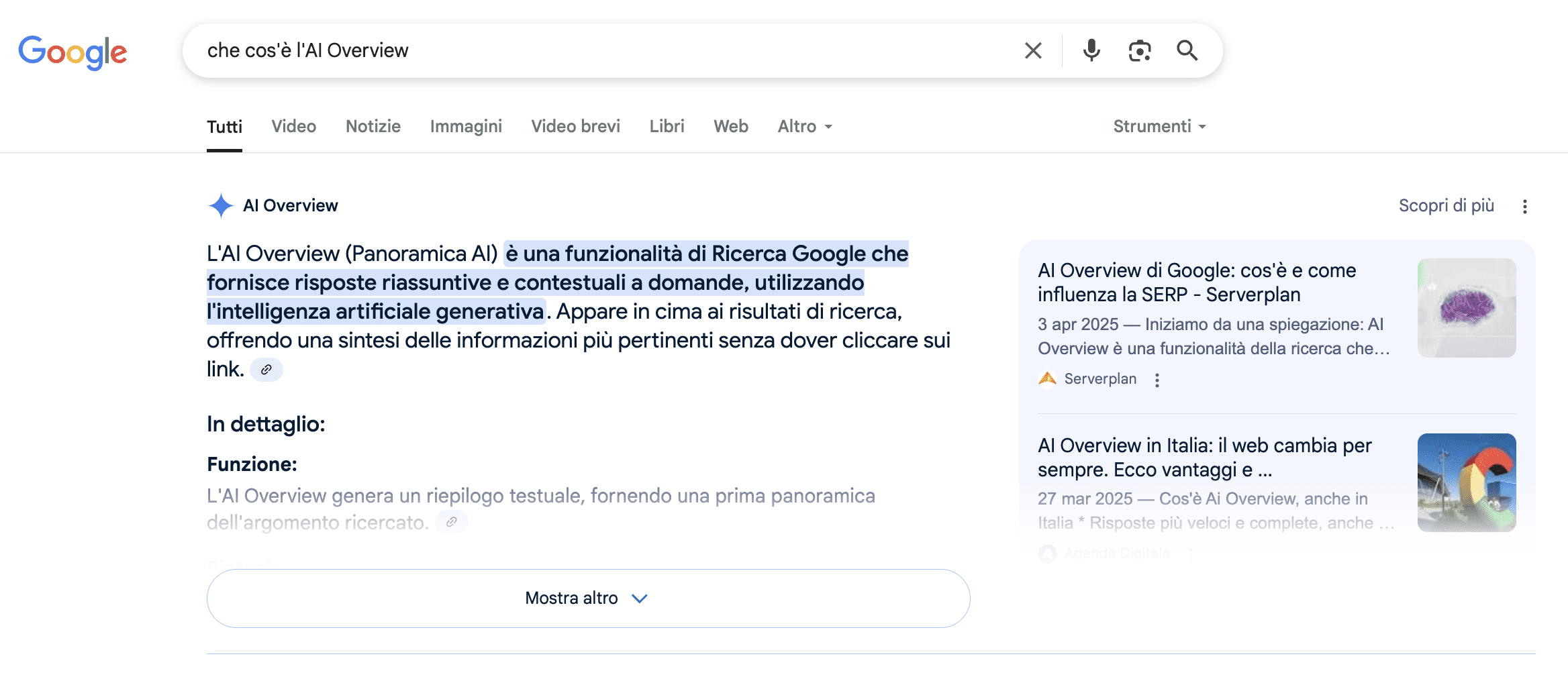
Faced with this evolution, Google risked losing its historic dominance over information search, and its traditional search started to compete with its own LLM, Gemini. Google had to react.
The strategic answer was the AI Overview, integrated directly in the search results pages (SERP). The move aims to keep user engagement inside Google’s own ecosystem, with AI-generated answers in an ever more prominent position.
This scenario, driven by consumer AI adoption and by the strategic answers of the large technology players, makes one thing urgent for senior roles in Marketing, Sales, Retail and Product. Understanding artificial intelligence and machine learning is the first step; the decisive one is to develop the mindset needed to govern this evolution.
This guide explains in simple terms what machine learning means in marketing, what concrete effects it has on the target and on market dynamics, and which mentality each decision-maker should cultivate to lead this cultural and technological change.
Machine learning vs artificial intelligence: the algorithms
The core of machine learning is its algorithms. They are the computational engines that analyse data, identify the underlying patterns and build predictive or descriptive machine learning models. This is the practical difference from AI as a whole: AI defines what the machine should be able to do, machine learning defines how it learns to do it.
There is a wide range of algorithms, each optimised for different types of problems and data. The main categories of machine learning are three.
Supervised learning. This is one of the most widespread and intuitive forms of machine learning. The algorithm is trained on a labelled dataset: for each input given to the system, the correct output is already known. The goal is to learn a function that maps inputs to outputs, so the system can make accurate predictions on new data it has never seen.
Classic examples are classification problems (separating spam from legitimate email) and regression problems (predicting the price of a property).
Its effectiveness depends on the quality and quantity of labelled data available for training.
A growing number of successful marketing applications rely on it for detailed customer profiling or for predicting future behaviour. For this reason, modern marketing teams need to understand its principles.
Labelling the data sometimes requires an intensive initial phase, but the predictive accuracy obtained is often higher than with other methods.
Unsupervised learning. Here the algorithm works on unlabelled data. The goal is to let the system discover hidden structures, recurring patterns or natural groupings (clustering) in the data, without prior guidance. In marketing it is valuable for segmenting customers by actual behaviour, for discovering associations between products (market basket analysis) and for identifying anomalies (anomaly detection). A striking example of autonomous learning, in a different field, is the humanoid robot developed at the Hasegawa Lab of the Tokyo Institute of Technology, based on a self-organising neural network (SOINN). The robot learns from its own experience, from the network and from other robots, through “logical-consecutive attempts” based on previous experience. The same principles of unsupervised learning find growing applications in marketing.
Reinforcement learning. This branch is based on an “agent” (the AI system) that learns to take optimal decisions by interacting with a dynamic environment. The agent receives feedback as rewards or penalties (the “reinforcements”) for its actions, and its final purpose is a strategy (policy) that maximises the total reward over time. Reinforcement learning is used for real-time personalisation of offers and content on websites, for dynamic optimisation of bidding strategies in online advertising auctions (RTB, real-time bidding) and for conversational systems that become more intelligent and adaptive.
The three categories of machine learning compared
Category
How it learns
Examples in marketing
Supervised learning
From labelled data, where the correct output is already known
Customer profiling, prediction of future behaviour
Unsupervised learning
From unlabelled data, discovering structures and groupings by itself
By interacting with an environment and receiving rewards or penalties
Real-time personalisation, bidding strategies in advertising auctions, dialogue systems
Source: Enrico Giubertoni's elaboration
Machine learning models in marketing
Once an algorithm has been trained on a specific dataset, the tangible result is a machine learning model: a mathematical representation of the knowledge and patterns the algorithm has learned from the data. The model is therefore ready to be queried and used to generate predictions, classifications or decisions on new data that was absent from the initial training set.
The applications of machine learning models in marketing are many, and they redefine how companies design and deliver their interaction with the market and with customers:
Advanced personalisation at scale. Machine learning analyses large and complex volumes of customer data to orchestrate personalised experiences at every touchpoint. Each user can consequently receive content, offers and recommendations calibrated on individual interests, preferences and needs.
Intelligent and dynamic audience segmentation. Segmentation goes beyond the limits of traditional demographics. Algorithms identify customer micro-segments by themselves, enabling more targeted communication and offers.
Recommendation engines. Global platforms have made recommendation engines, based on complex machine learning models, one of the main factors of their success, with significant gains in engagement and conversion opportunities.
Predictive analysis for proactive decisions. Machine learning anticipates future customer behaviour (for example churn prediction and the estimate of customer lifetime value), so marketers can intervene early and with precision.
Continuous optimisation of advertising campaigns. From precise target definition to dynamic budget allocation, machine learning is crucial to maximise the ROI of campaigns.
Intelligent chatbots and virtual assistants. They serve the customer in after-sales support and, above all, during the purchase, as a reinforcement of the sale. Thanks to Natural Language Processing (NLP, the technology that lets machines understand human language), modern chatbots understand and answer customer requests in an increasingly natural way, 24 hours a day, 7 days a week.
Stronger content marketing and SEO. Machine learning analyses content trends, suggests topics, supports search engine optimisation and assists in drafting content. With AI Overviews this aspect becomes even more critical.
Sentiment analysis for brand reputation. Algorithms analyse the sentiment users express online and deliver valuable insight on how the brand is perceived.
Why marketing, sales, retail and product need machine learning
For companies that aim at excellence, the strategic and conscious adoption of machine learning in business processes has become a competitive necessity. Its effect reaches beyond marketing into sales, retail and product development, and creates a virtuous circle of data-driven intelligence. For this reason, senior roles in these functions must understand its strategic value:
Marketing. Machine learning strengthens every aspect of contemporary marketing: it moves the function from intuition to data and prediction, and maximises effectiveness and ROI. This is what I explain in my AI marketing training programmes.
Sales. Machine learning models change sales processes through intelligent lead scoring (ranking prospects by probability of purchase), sales forecasting and personalised commercial proposals. Sales teams can consequently focus their effort on the most promising opportunities.
Retail. Machine learning enables a personalised shopping experience, optimised stock management, fraud prevention and dynamic pricing.
Product. The analysis of customer feedback and usage data, strengthened by machine learning, delivers crucial input to innovate, to develop new products and to improve existing ones.
From a deep and granular understanding of the customer to the intelligent automation of campaigns, machine learning gives managers and their teams the possibility to work in a more intelligent way, take better-informed decisions and build stronger, more meaningful and more profitable relationships with their audience.
Embracing these technologies with an open and strategic mentality is a necessity to remain competitive and to lead innovation in contemporary business, especially with evolutions such as Google’s AI Overview that keep redefining the field.
Further reading: frequently asked questions on machine learning and AI in search
To clarify some key terms and emerging concepts:
Machine learning vs artificial intelligence: how are they related?
Artificial intelligence is the wider horizon: the ambition to build machines and software with cognitive abilities similar to human ones, such as reasoning, understanding language, visual perception and learning. Machine learning is therefore one of the most effective and widespread methods to reach that goal. It is the technology that makes AI systems progressively more capable, by analysing data and adapting their behaviour. In short: all machine learning is AI, while part of AI works without machine learning.
How does machine learning relate to deep learning?
Deep learning is an advanced subset of machine learning. It uses artificial neural networks, a series of algorithms modelled on the human brain, built with many processing layers (hence “deep”). The layers process data in a hierarchical way, so the system learns very complex and abstract representations. Deep learning performs particularly well in sophisticated tasks such as advanced image recognition, machine translation and the semantic analysis of natural language that powers, for example, Google’s AI Overviews.
Why should a marketing or sales director understand machine learning?
Because machine learning already decides part of what the customer sees: search results, recommendations, prices and advertising. A director who knows the three learning types can ask the right questions to suppliers and internal teams, read the limits of a model and govern generative AI with a clear mindset, instead of delegating the decision to the tool.