
From customer to value
Brian Solis, Engage and the Conversation Prism: community before channels
Trusted by
- Worldline
- Alba Leasing
- L'Erbolario
- 3M
Brian Solis, a leading expert in social media and creator of the well-known Conversation Prism (a visual map of social media, explained below), has published his latest work, with an explicit title:
Engage: The Complete Guide for Brands and Businesses to Build, Cultivate, and Measure Success in the New Web
The book is available on Amazon, and Brian Solis presented it in an official post on his blog. The notes below start from that presentation post and add some quotations of my own.
What are the premises of the book?
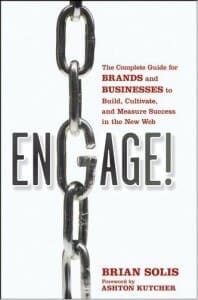
The work of Solis starts from the idea that social media are tools of influence built on a democratic approach. They are changing the way companies communicate with customers and prospects (people who may become customers), and in this new model the role of peers emerges: customers and prospects influence one another.
Solis, like others, stresses that companies need platforms such as Twitter, YouTube and Facebook for their brand communication. He then adds some important considerations.
What is the theme of the book: how and where to build engagement?
Solis holds that engagement (the willingness of people to take part and to share) is not the logical consequence of being present.
Engagement is formed by interpreting the intentions of the user
To involve a person you need to:
- share conversations that carry meaning
- communicate and share the benefits of those meanings
- involve customers and prospects in sharing those benefits with their peers
The third point seems important to me, because when we share links on social networks we put our own reputation at stake.
According to Solis, participatory media (media where the audience also produces content) will contribute to the success of 21st-century businesses. I would add that they will shape the economic models of this decade and the next.
Following the anthropological approach of Solis, Engage should help the reader to:
- create a space in the online ecosystem that represents the brand sincerely and effectively, and sets the conditions for loyalty and trust among customers;
- establish an organisational structure able to absorb new media and emerging trends;
- understand the dynamics that reveal which social networks are best suited to carry the online brand.
The work of Solis is, in its intention, an important piece of the answer to a complex question: online communication and the changing role of companies on the network.
By the changing role of companies I mean the dynamics typical of the network that seem to me to recover the one-to-one interaction (one seller speaking with one buyer) of the fairs and craft markets of the past. They now combine it with the growing sophistication of the products that technological innovation makes possible.
Community before channels: why is marketing a social science?
Community before channels means that a company studies how the group of people it cares about is born and grows, and only then decides on which platforms to be present. An online community is a group of people who talk to one another around a shared interest. The channel (Twitter, YouTube, a forum, a professional group) is only the place where that conversation happens.
In August 2008 I wrote that anyone doing marketing on social media should think as a sociologist and an anthropologist do. Sociology studies how groups work, anthropology how the habits of a community take shape. I added a concern for semiotics, the discipline that studies how signs produce meaning. The reason is simple: if a company does not understand how and why a community of people grows, its campaign is useless. That sentence seems more useful today than then. Channels have multiplied and publishing tools cost little, while understanding people takes the same effort as always.
What does the Conversation Prism say?
The Conversation Prism is a visual map of social media. Brian Solis and the studio JESS3 presented version 1.0 on 5 August 2008, and Solis announced version 3.0 on 13 October 2010. The map groups platforms into categories, following how people really use them rather than the technology behind them. Solis gives it three purposes: to show the social landscape, to help people inside a company listen and learn across networks, and to prepare the ground for social CRM (customer relationship management extended to the conversations that happen on social media), that is, to show how those conversations affect sales and support.
The part that interests me most is where the map places the reader. Whoever works in communication or customer service stands at the centre of the prism, and from there observes, listens or takes part. In my 2008 post I also quoted a sentence by Solis: in the social economy, relationships are the new currency.
How do you observe a community before choosing channels?
The order of operations below comes from the Conversation Prism and from the principles of Shana Albert (author of the blog Social Desire, 15 August 2008), which I commented on in 2008:
- Map where the people of your target already talk, instead of starting from the platforms where the company would like to be.
- Listen. Social listening (the systematic monitoring of what is said about a topic or a brand on social media) lets you search by keyword on each network and see whether a presence there is worth opening. Solis wrote this in 2010, when monitoring tools were still at an early stage.
- Join a conversation that already exists before trying to host one of your own without a strategy. For Albert, the first recommendation for anyone starting a social campaign is to watch and take part in the existing forums.
- Take part with a precise reason. Solis recommends entering each community with a mission, a purpose and a point of view that adds value.
The principles with which Albert closed her article remain the best reminder I know:
- you do not need to own the traffic, you need to own the relationship;
- you cannot control the conversation, you listen and you respond;
- one size does not fit all, and neither does one message;
- talking with your customers can teach you something.
What changes for a B2B company?
In B2B (business to business sales) the community is made of peers by role: purchasing managers, plant managers, quality managers, finance directors. They meet in professional groups, sector forums, events and the chats of their professional bodies. Imagine a manufacturer of packaging machines that sells to food plants. Its buyers exchange opinions on a supplier before they ever speak to a salesperson, and that opinion weighs more than any brochure. The effect has a name, social proof: we trust what people like us do and say.
For the middle manager who decides where to spend the communication budget, the four steps become a starting question: where do our buyers get their information, and whom do they listen to? An answer to that question is worth more than a calendar of posts on the fashionable platform. It is also the reason why the third point of Solis, involving customers and prospects in sharing the benefits with their peers, remains the pivot of engagement. In a professional community, whoever shares a content vouches for its quality with their own reputation.
Sources for this section
- Brian Solis, «Introducing the Conversation Prism Version 3.0», 13 October 2010: date of version 1.0 (5 August 2008), purposes of the map, keyword listening, engagement with mission and value.
- Shana Albert, «How many businesses really “get” the social web?», blog Social Desire, 15 August 2008 (page no longer reachable; the principles are those I reported in my post of 17 August 2008).
- Enrico Giubertoni, «Sociology and anthropology have a key role in marketing strategies of the social communications era: introducing the conversation prism», 13 August 2008, on the former Buzzes blog.
References
- Engage: The Complete Guide for Brands and Businesses to Build, Cultivate, and Measure Success in the New Web: Amazon.com
- Official presentation post of Engage on the blog of Brian Solis
Frequently asked questions
What does Engage by Brian Solis ask of a brand?
Engage is the guide by Brian Solis for brands and companies that want to build, cultivate and measure success on the new web. It starts from the idea that social media are democratic tools of influence. They are changing how companies communicate with customers and prospects, and they bring out the role of peers, who influence one another.
According to Brian Solis, is being present on social media enough to obtain engagement?
No. Brian Solis holds that engagement does not follow automatically from being present. It comes from interpreting what the user intends. To involve a person you need to share conversations that carry meaning, communicate the benefits of that meaning, and involve customers and prospects in sharing those benefits with their peers.
Why does sharing among peers matter so much in social media marketing?
Because when we share a link on a social network we put our own reputation at stake. For this reason, involving customers and prospects in sharing the benefits with their peers seems to me the most important point of the approach in Engage by Brian Solis.
Why should a B2B company study its community before choosing channels?
A channel is only the place where a conversation happens. If the company does not know who its buyers listen to, it cannot tell which platform deserves its time. The Conversation Prism offers a map for observing and listening first, and for taking part afterwards, with a clear purpose.
In the same area

What are your business challenges?
Tell me about your priorities and the goals you want to reach.
Enrico Giubertoni will give you targeted feedback within one business day.