
AI Governance
Organizational digital transformation: 4 key learnings from three speeches
Trusted by
- Worldline
- Alba Leasing
- L'Erbolario
- 3M
Organizational digital transformation (the change by which a company uses digital technologies to redesign its business model, its processes and its relationship with the market) is a necessity for every company that wants to remain competitive and grow in a sustainable way. It is a complex path, and it opens a large potential: redefining the interaction with customers, optimising processes and innovating business models.
This article is for CEOs, marketing and sales directors and HR managers who lead or prepare a transformation, and want to understand its dynamics before investing in it.
Members area Coming soon
Free tools for your work: your result in two minutes
Calculators for marketing, sales, HR and R&D. Leave your email and we will tell you when it opens.
Thank you. We will write to you once, when the area is live.
As an international keynote speaker, my role is to provide interpretative models, strategic analysis and concrete examples for the digital transformation of companies. In 2018 I was engaged as a speaker at three relevant events, where I presented three speeches designed specifically for each audience.
From the analysis of these speeches we can extract the pillars and the fundamental dynamics of the change that digital transformation brings to organisations.
The three events were the Settimana della Formazione (an Italian week dedicated to professional training), Milano Digital Week and Cosmoprof Worldwide in Bologna, the international trade fair of the cosmetics industry. The sections below describe each speech, then the four key learnings that derive from them.

Settimana della Formazione: building your brand on digital, why and how, with a social strategy
In the speech “Building Your Brand on Digital: Why Do It, How to Do It and How to Define an Effective Social Strategy”, presented at the Settimana della Formazione, I analysed how digital transformation imposes a radical rethinking of brand building. The key messages were:
- The brand as a dynamic experience in the digital era:
- My analysis: in the digital era the brand goes beyond the logo and evolves into a continuous conversation and an omnichannel experience for the customer (one experience across physical and digital channels). It follows that its strength lies in the capacity to generate lasting trust and loyalty.
- Its strategic value: the brand is the “Why” that must align and guide all digital marketing strategies. Its return on investment is therefore concrete: it attracts and retains customers and talent who recognise themselves in the company’s values.
- Social strategy and the new customer experience:
- My analysis: digital transformation imposes a paradigm change, from mostly one-directional communication to an interactive dialogue on social media. For this reason these channels become essential to shape the customer experience, collect valuable feedback and personalise the interaction.
- Building the digital brand: companies must define their distinctive values clearly in the digital ecosystem, understand the new behaviours of their customers, select the most effective social channels, create and distribute content of real value and measure performance constantly. The steps are described in detail in the article on how to build brand equity.
- The brand as an indispensable pillar of corporate transformation:
- My analysis: a solid and coherent digital brand identity is a fundamental element for the success of a wider corporate transformation. A concrete example I presented: B2C companies, even in traditional sectors, that renewed their image and reached new market segments through a well orchestrated digital and social branding strategy, focused on authenticity and on direct engagement.
Milano Digital Week: social media, from customer care tool to instrument of persuasion
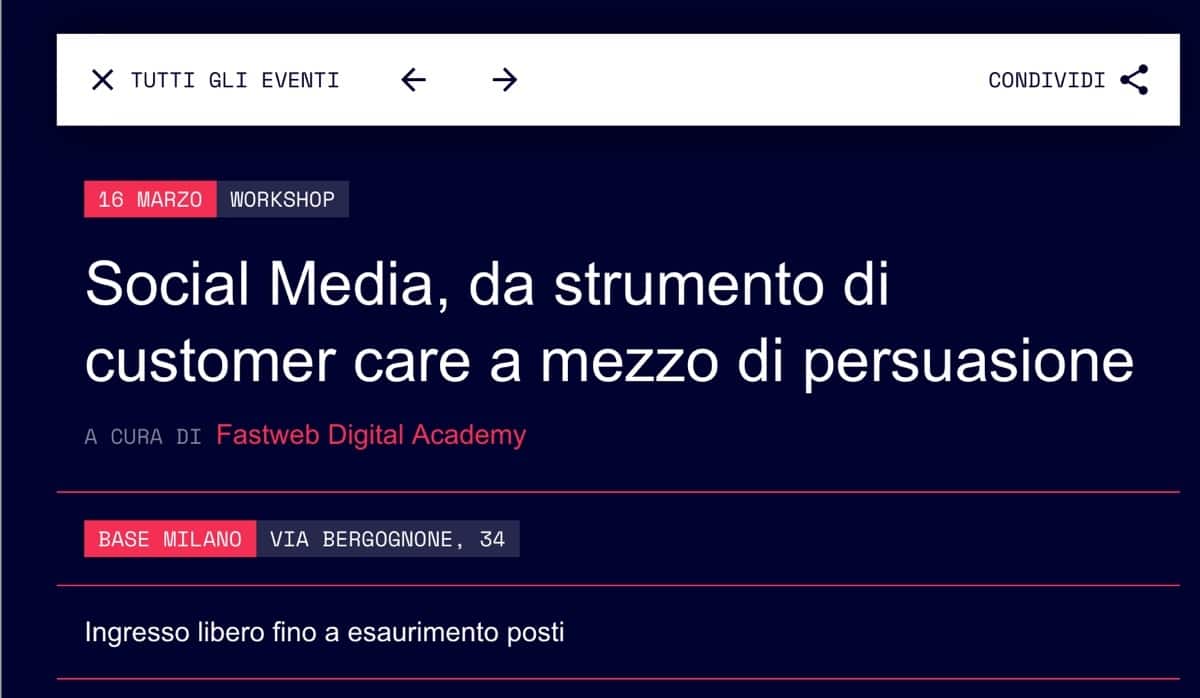
In the speech “Social Media: From Customer Care Tool to Powerful Instrument of Digital Persuasion”, presented at Milano Digital Week as a guest of IAB Italia and Fastweb Digital Academy, I explored the evolution of social media within digital transformation. I designed the speech to show how companies can transform these channels into strategic levers:
- Social media as strategic business assets:
- My analysis: in organizational digital transformation, social media become active engines for persuasion and for the generation of highly qualified leads, beyond their role as customer support platforms or showcases.
- Focus on conversion: the emphasis was on transforming engagement (the like or the comment) into measurable and concrete business results (the conversion into customers or sales).
- Artificial intelligence and marketing automation for effective persuasion:
- My analysis: the strategic integration of artificial intelligence (AI) and marketing automation with CRM systems (the software that manages customer relationships) is the keystone. These instruments allow an advanced profiling of potential buyers and the orchestration of marketing actions that are personalised, relevant and timely: central elements, therefore, of the modern digital transformation of companies.
- Efficiency and scalability as necessities: this evolution is a clear example of digital transformation and innovation applied with success, because it allows companies to scale interactions and campaigns with a very high degree of personalisation. One example I discussed: e-commerce platforms that use AI to analyse browsing behaviour and suggest related products in real time, and automated lead nurturing campaigns that accompany the prospect through the sales funnel with targeted communications based on previous interactions.
- The decisive impact on competences and on the organisation:
- My analysis: adopting these technologies for digital persuasion requires developing new competences without delay (a fundamental aspect of the link between digital transformation and organisational capacity) and, as a consequence, rethinking workflows and the cooperation inside marketing and sales teams.
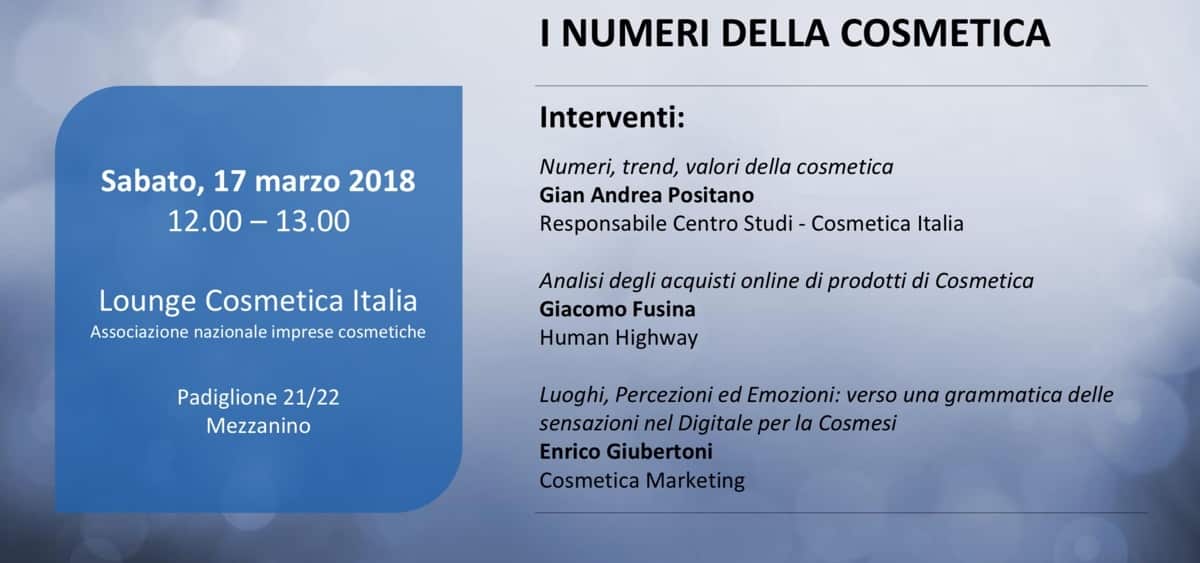
Cosmoprof Worldwide 2018: places, perceptions and emotions, a grammar of sensations in digital for cosmetics
In the speech “Places, Perceptions and Emotions: Towards a Grammar of Sensations in Digital for Cosmetics”, presented at Cosmoprof Worldwide as a guest of Cosmetica Italia (the Italian association of cosmetics companies), I addressed the challenge of translating sensory experiences into the digital context, a challenge particularly felt in the cosmetics sector. The key concepts I explored with the audience were:
- Digitalising the sensory and emotional experience in cosmetics, and beyond:
- My analysis: the crucial question was how to communicate online tactile and olfactory sensations, or the experience of a cosmetic product. I proposed defining a “grammar of perception and emotion on digital media”, with strategic visual storytelling, evocative texts, intuitive user interfaces and immersive technologies such as augmented reality (AR, digital images overlaid on the real world through a screen).
- The centrality of customer experience: the objective is a user experience that, even when mediated by digital technology, is rich and deeply engaging.
- Building trust and authentic perception in digital:
- My analysis: in the digital environment the perception of quality and authenticity of a brand and its products is built through the coherence of messages, transparent information, the reviews of other users and the overall quality of every interaction. For this reason the positive emotion generated by an excellent user experience becomes a decisive factor in the purchase process and in building solid trust.
- Understanding people in digital transformation: it is crucial to understand how customers perceive, interact and connect emotionally in the digital environment, in order to design effective strategies. A clear example from cosmetics I presented: AR filters on social media or websites that allow users to “try” different shades of make-up virtually. They entertain and engage, reduce the uncertainty of the online purchase and, therefore, create an emotional connection with the product before the customer owns it.
- Emotion as a strategic lever of value in the purchase process:
- My analysis: an emotionally satisfying experience is a strategic engine for generating value, for the active involvement of the customer and for reassurance during the purchase process. It follows that this approach influences the customer lifetime value (the total revenue a customer generates over the whole relationship) and guides corporate transformation with success.
Organizational digital transformation: 4 key learnings from my experience as a speaker
From my activity as an international keynote speaker and from the analysis that emerged in these speeches, I have distilled some key learnings. They are a strategic synthesis that I share constantly to guide companies in their digital transformation.
First, one concept must be clear. Digital transformation is a cultural change and an operational one: with digital technologies it reinvents business models and the way a company interacts with the market. The most complete definition includes people, processes and technologies, all aligned towards new horizons, where corporate culture, expressed in its values, acts as the sextant that guides the organisation through the complexity of change. The sextant is the navigation instrument that measures the position of a ship from the stars: it gives direction where a map alone is not sufficient.
The consolidated key learnings:
- Corporate culture is our sextant, more than a map: values and culture are the real sextant, the precise navigation instrument that guides every strategic decision and every operational manoeuvre. Without a culture actively ready for change, even the largest technology investments risk being wasted.
- Customer experience (CX) is our strategic pole: every digital transformation initiative must have as its final aim a tangible improvement of the customer experience. For this reason, understanding the customer deeply is essential.
- Strategic integration is the real power of transformation: the strength of transformation lies in the integration of technology instruments with processes and with the competences of people. It follows that the approach must be holistic.
- Agility and continuous learning, the fuel for a journey without end: digital transformation is a constant evolutionary path. The capacity to adapt quickly (agility) and to learn continuously is therefore crucial for digital growth.
These key learnings, tested in the field, lead to a more structured understanding of how digital transformation affects the different areas and functions of the company.
Digital transformation of companies: a redesign guided by vision
Because of these key learnings, in the three speeches I showed how the digital transformation of companies is a holistic and deeply strategic redesign of the whole organisation.
Guided by the sextant of their culture and by a visionary leadership, companies must pursue agility and become data-driven (they decide on the basis of data). A digital transformation specialist, capable of orchestrating change, can accompany this path.
The final objective is a resilient and proactive company, able to seize the opportunities of a complex digital ecosystem.
Digital transformation objectives: concrete targets for the future
The objectives of digital transformation derive logically from the necessity to excel in customer experience and to operate with strategic agility. They include:
- Optimising operational efficiency with determination.
- Personalising offer and communication in depth.
- Using data for informed strategic decisions.
- Starting and sustaining a virtuous cycle of continuous innovation.
- Ensuring robust and sustainable digital growth.
Digital transformation examples: innovation in real cases
As emerged from my speeches and from the observation of the market, digital transformation takes different forms. Analysing concrete examples is therefore illuminating:
- Cosmetics (from the speech “Places, Perceptions and Emotions”): cosmetics brands use augmented reality to let customers “try” make-up virtually. This approach improves engagement, reduces uncertainty and creates a personalised and memorable customer experience.
- Branding and community (from the speech “Building Your Brand on Digital”): brands that built loyal online communities through authentic content on social media and influencer marketing. These brands use their digital identity to communicate values and create a sense of belonging, and this stimulates digital growth.
- Automation and personalisation in sales (from the speech “Social Media: From Customer Care Tool”): B2B companies that implement advanced CRM systems integrated with AI to track the interactions of leads and automate personalised communications. In this way they optimise the effectiveness of digital transformation in generating revenue.
These examples show how strategy, technology and attention to the customer can converge to create value.
Digital transformation and organisational capacity: people at the centre of change
Finally, digital transformation and organisational capacity are linked to the principles of continuous learning and strategic agility described in the key learnings. It follows that organizational digital transformation goes far beyond a technology update, and requires a deep commitment on several fronts:
- A strategic investment in the employees: targeted training programmes.
- The active promotion of a corporate culture, our sextant, that values experimentation and collaboration.
- A courageous review of organisational models, to make them leaner and more flexible.
- An enlightened leadership, capable of inspiring and guiding people concretely.
Without a determined and constant focus on the organisation and on the development of its human capital, even the most sophisticated technology strategy cannot express its full potential. If your company is preparing this path, the AI transition programme works on the competences and the organisation that a transformation requires.
Frequently asked questions
Why is digital transformation decisive for companies today?
Because customers expect smooth digital experiences, competitors move quickly, and technologies offer large opportunities to improve efficiency, create new products and services and understand the market better. It is therefore a question of relevance and competitiveness.
Which are the pillars of digital transformation?
Traditionally three: People, Processes and Technologies. I add a fourth with conviction, Corporate Culture, which is the real engine or brake of every change. The four pillars are therefore: 1. Culture; 2. People; 3. Processes; 4. Technologies.
Which key learnings guide an organisation's digital transformation?
Four. Corporate culture is the sextant that guides every decision. Customer experience is the strategic pole of every initiative. Strategic integration joins technologies, processes and people. Agility and continuous learning keep the journey going, because transformation never ends.
In the same area

What are your business challenges?
Tell me about your priorities and the goals you want to reach.
Enrico Giubertoni will give you targeted feedback within one business day.